
07 May
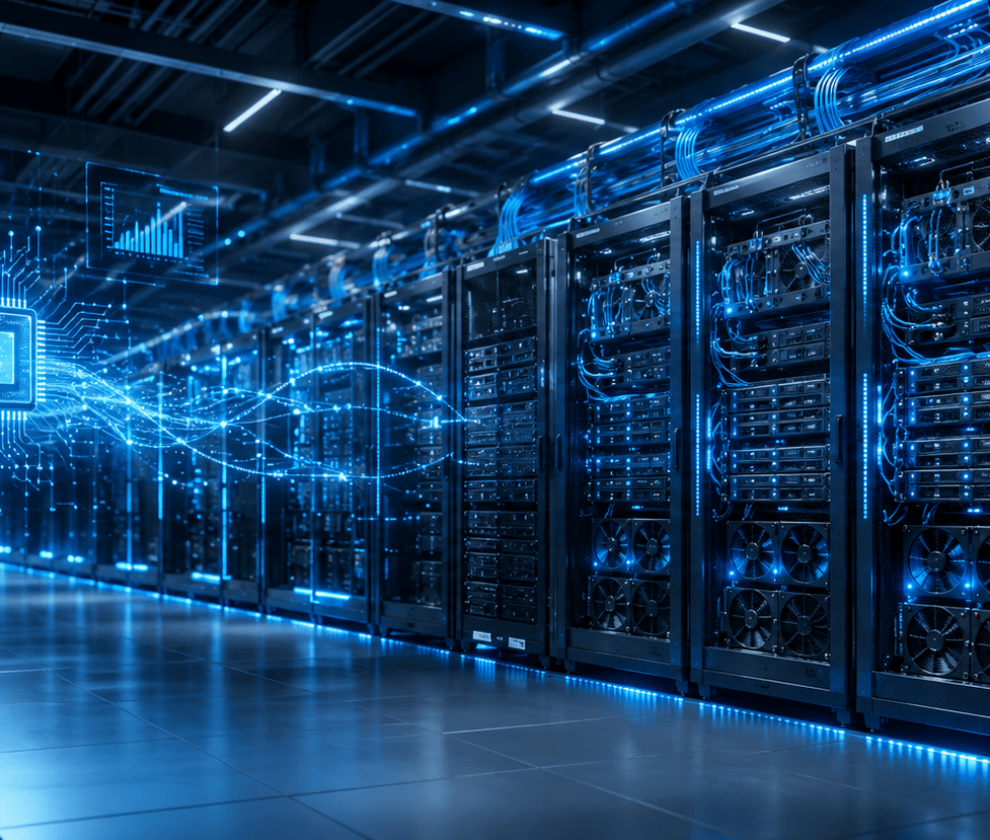
GPU servers are redefining the design and performance of modern artificial intelligence and high-performance computing data centres. Originally developed to accelerate graphics rendering, Graphics Processing Units are now widely used for machine learning, deep learning, scientific simulation, engineering analysis, image processing, generative AI, and large-scale data analytics.
Unlike conventional processors that handle a smaller number of complex tasks sequentially, GPUs can process thousands of operations in parallel. This makes them highly effective for workloads that involve repeated mathematical calculations across large datasets. As a result, organisations are increasingly building specialised GPU infrastructure to reduce processing time, improve research productivity, and support advanced digital applications.
Accelerating AI Training and Inference
Artificial intelligence models require substantial computing power during both training and inference. Training involves processing large datasets repeatedly to adjust model parameters and improve accuracy. Large language models, computer vision systems, recommendation engines, and predictive analytics platforms may require multiple GPUs operating together.
GPU servers significantly reduce the time required to train these models compared with CPU-only systems. Workloads that might take weeks on traditional infrastructure can sometimes be completed in days or hours, depending on the application and system design.
For inference, GPUs enable trained models to process user requests, images, video, sensor information, or business data quickly. This is important for real-time applications such as intelligent surveillance, autonomous systems, medical imaging, virtual assistants, fraud detection, and industrial automation.
Supporting High-Performance Computing
GPU servers are also transforming traditional HPC environments. Research institutions, engineering companies, universities, and laboratories use GPU acceleration for weather modelling, computational fluid dynamics, molecular analysis, seismic processing, digital twins, financial modelling, and scientific simulation.
Many of these workloads involve large matrices and repeated calculations that can be processed efficiently across thousands of GPU cores. By combining CPUs and GPUs within the same cluster, organisations can assign different parts of a workload to the most suitable processor.
This hybrid computing approach improves performance while allowing existing scientific and engineering applications to benefit from accelerated infrastructure.
Changing Server and Cluster Architecture
Modern GPU servers may contain one, two, four, eight, or more GPUs within a single chassis. Large-scale AI data centres connect multiple GPU servers into clusters, creating a shared computing platform for researchers, developers, and business teams.
These systems require high-speed internal communication between GPUs and low-latency networking between servers. Technologies such as high-bandwidth GPU interconnects, 100GbE, 200GbE, 400GbE, and InfiniBand help reduce communication bottlenecks during distributed workloads.
A separate management network may also be used for administration, monitoring, scheduling, and remote access.
Increasing Power and Cooling Requirements
GPU servers deliver exceptional performance, but they also consume considerably more electricity than conventional enterprise servers. A high-density GPU rack may require significantly greater power capacity, stronger electrical distribution, intelligent rack PDUs, and larger UPS systems.
Cooling is equally important. When GPUs run at high utilisation for extended periods, they produce substantial heat. Standard room cooling may not be sufficient for dense AI and HPC environments.
Depending on the rack load, data centres may use hot-aisle containment, in-row cooling, rear-door heat exchangers, direct-to-chip liquid cooling, or immersion cooling. Continuous monitoring of temperature, humidity, airflow, and water leakage is essential for safe operation.
Driving Storage and Network Modernisation
GPU performance can be limited if storage systems cannot deliver data quickly enough. AI and HPC data centres therefore require high-speed NVMe storage, scalable shared storage, parallel file systems, and efficient data pipelines.
Large datasets must move quickly between storage and computing nodes. Organisations may use different storage tiers for active datasets, model checkpoints, temporary processing, backup, and long-term archiving.
Networking must also support continuous data exchange between GPUs and storage platforms. A poorly designed network can leave expensive GPU resources underutilised, reducing the value of the investment.
Improving Resource Utilisation
GPU servers represent a significant infrastructure cost, so efficient utilisation is essential. Cluster management and workload scheduling platforms can allocate GPU resources among different users, projects, or departments.
Containerisation and virtualisation can help standardise software environments and allow multiple teams to share the same infrastructure securely. Monitoring tools can track GPU utilisation, memory usage, temperature, power consumption, and job performance.
These capabilities help organisations identify idle resources, balance workloads, and plan future expansion.
Enabling the Next Generation of Innovation
GPU servers are transforming data centres from general-purpose IT facilities into accelerated computing platforms. They enable faster AI development, advanced scientific research, high-resolution simulation, real-time analytics, and data-driven innovation.
However, successful deployment requires more than selecting powerful GPUs. Organisations must carefully plan server architecture, memory, storage, networking, power, cooling, software, security, and scalability.
A properly designed GPU data centre delivers higher performance, better resource utilisation, and the flexibility to support future AI and HPC workloads. As artificial intelligence and data-intensive computing continue to grow, GPU servers will remain a central technology shaping the next generation of enterprise and research infrastructure.