Power, Cooling and Networking Strategies for Efficient Data Centres

Power, cooling, and networking form the operational foundation of every modern data centre. Servers, storage platforms, GPU systems, switches, security equipment, and cloud infrastructure depend on these three systems to operate continuously and efficiently. When they are planned separately or incorrectly sized, organisations may experience downtime, excessive energy consumption, overheating, network congestion, and limited expansion capacity.

An efficient data centre requires an integrated strategy in which electrical infrastructure, thermal management, and connectivity are designed around present workloads and future business growth.

Improving Cooling and Airflow Management

Every electrical device in a data centre generates heat. If this heat is not removed efficiently, equipment performance may decrease and components may fail prematurely.

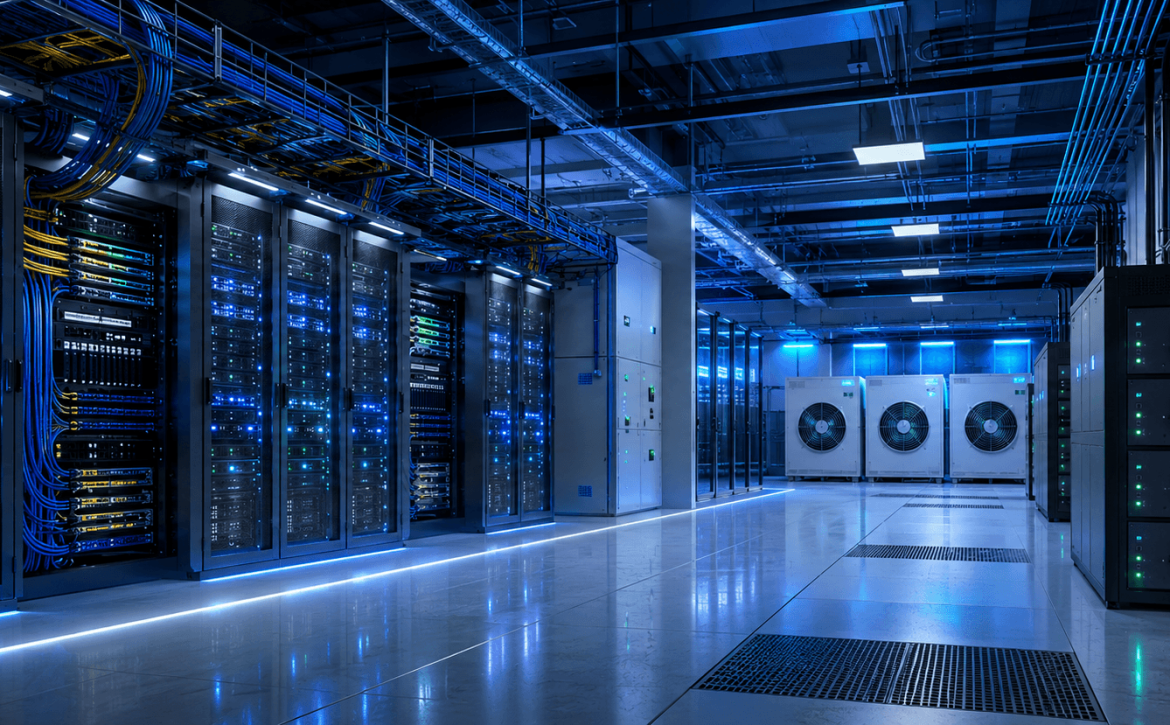
A hot-aisle and cold-aisle rack arrangement is one of the most effective ways to improve airflow. Cold air is supplied to the front of the racks, while hot exhaust air is directed towards the rear. Containment systems can further prevent hot and cold air from mixing.

Blanking panels should be installed in unused rack spaces to stop hot air from circulating back to equipment inlets. Cable openings should be sealed, and poorly organised cabling should not block airflow.

Precision air-conditioning systems are designed to maintain stable temperature and humidity levels. Depending on the facility size and rack density, organisations may use perimeter cooling, in-row cooling, rear-door heat exchangers, or containment-based solutions.

High-density AI and HPC environments generate significantly more heat than conventional server rooms. These facilities may require direct-to-chip liquid cooling, immersion cooling, or hybrid air-and-liquid cooling systems.

Temperature, humidity, airflow, and water-leakage sensors should be installed at multiple points. Rack-level monitoring is especially important because a normal room temperature does not guarantee that every server is receiving sufficient cooling.

Designing High-Performance Networks

A data centre network must provide reliable, secure, and scalable connectivity between users, servers, storage platforms, cloud services, and external networks.

The architecture may include core, aggregation, and access switches, depending on the size of the facility. Smaller environments may use simplified designs, while large data centres may implement leaf-and-spine architecture to deliver predictable performance and lower latency.

Redundant switches, network links, internet connections, and power supplies reduce single points of failure. If one path or device becomes unavailable, traffic should move automatically through an alternative route.

Bandwidth must be selected according to workload requirements. Standard enterprise applications may operate effectively on 10GbE or 25GbE connections, while storage, AI, and HPC clusters may require 100GbE, 200GbE, 400GbE, InfiniBand, or specialised low-latency interconnects.

Production, storage, backup, management, and security traffic should be logically or physically separated. This prevents bandwidth-intensive backup operations from affecting business applications and reduces the risk of unauthorised access.


Structured Cabling and Documentation

Copper and fibre cabling should be installed through organised pathways, properly labelled, tested, and documented. Data cables should be separated from electrical cabling to minimise interference and improve safety.

Accurate diagrams and cable records help technical teams locate faults, perform upgrades, and make infrastructure changes without unnecessary downtime.

Monitoring and Continuous Optimisation

Data Centre Infrastructure Management platforms can combine power, cooling, environmental, rack-capacity, and equipment information into a central dashboard. Operators can identify overloaded circuits, inefficient cooling, unused capacity, hot spots, and abnormal network behaviour before they create service interruptions.

Efficient data centres are not achieved through individual equipment purchases alone. Power, cooling, and networking must be designed, monitored, and maintained as one integrated system. A balanced strategy improves uptime, reduces energy costs, protects equipment, and provides the scalable foundation required for cloud, AI, enterprise, and high-performance workloads.

Read More

AI Data Centres: Infrastructure Requirements for High-Performance Workloads

Artificial intelligence is transforming industries by enabling advanced automation, predictive analytics, natural language processing, computer vision, scientific research, digital engineering, and generative AI applications. However, these workloads require significantly more computing power, memory, storage performance, and network bandwidth than conventional enterprise applications.

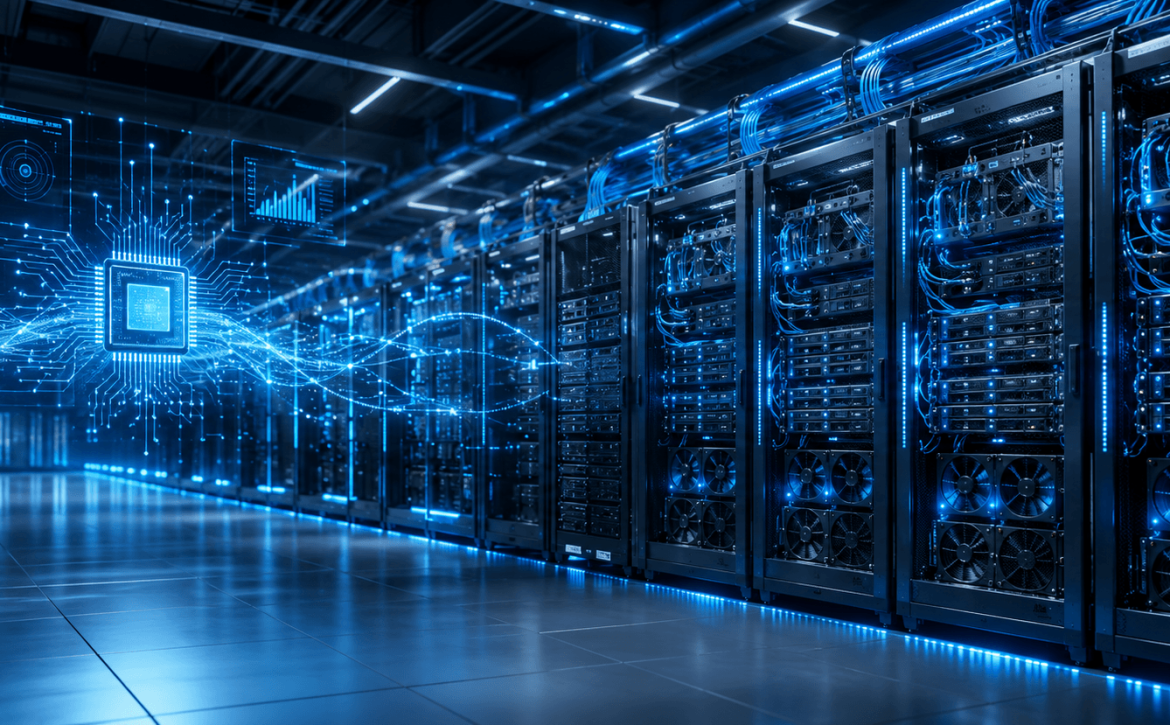
An AI data centre must therefore be designed as a specialised high-performance environment. Its infrastructure must support GPU-intensive computing, large datasets, continuous processing, high rack power density, and rapid communication between servers. A balanced design across computing, storage, networking, power, cooling, software, security, and monitoring is essential for reliable performance.

High-Performance GPU Computing

The core of an AI data centre is its accelerated computing platform. AI training and inference workloads commonly use GPU servers because GPUs can perform thousands of calculations simultaneously. This parallel-processing capability makes them suitable for deep learning, large language models, image processing, simulation, and data-intensive research.

AI servers may contain one or multiple GPUs, depending on the workload. Large-scale environments often connect several GPU servers to create a computing cluster. The server platform must provide sufficient processor performance, PCIe connectivity, system memory, storage interfaces, and internal bandwidth to avoid limiting GPU utilisation.

The infrastructure should also be scalable so that additional GPU nodes can be added as projects, datasets, and model sizes increase.

Large Memory and High-Speed Storage

AI applications frequently process large datasets and complex models. As a result, servers may require hundreds of gigabytes or several terabytes of system memory. Balanced memory configuration across processor channels is important for maintaining consistent performance.

Storage must be capable of delivering data quickly enough to keep GPUs active. Slow storage can create a bottleneck, leaving expensive computing resources underutilised.

AI data centres typically use multiple storage tiers. High-speed NVMe SSDs may support active datasets, training processes, and temporary workloads. Shared storage systems or parallel file systems can provide data access across multiple compute nodes. High-capacity storage may be used for raw datasets, model checkpoints, archives, and backups.

A suitable data protection strategy should also include replication, backup, retention policies, and disaster recovery.

Low-Latency, High-Bandwidth Networking

Networking is a critical component of AI infrastructure. During distributed model training, GPU servers exchange large volumes of data continuously. If network bandwidth is insufficient or latency is too high, the entire cluster may experience reduced performance.

Depending on the workload and scale, AI data centres may use 100GbE, 200GbE, 400GbE, InfiniBand, or other high-speed interconnect technologies. Redundant network paths can improve availability and reduce the risk of service interruption.

Separate networks may also be used for production traffic, storage communication, cluster management, backup, and remote administration. This improves performance, organisation, and security.

High-Density Power Infrastructure

GPU servers consume considerably more electricity than conventional enterprise servers. An AI rack may therefore require significantly higher power capacity.

The electrical system should include properly sized UPS systems, battery backup, generators, power distribution units, rack PDUs, earthing, surge protection, and real-time power monitoring. Redundant power paths may be required for mission-critical environments.

Capacity planning must account for current equipment, peak demand, cooling systems, and future expansion. Underestimating power requirements can result in overloaded circuits, limited scalability, and operational risk.

Advanced Cooling Solutions

High-performance GPU systems generate substantial heat, especially when operating continuously at full utilisation. Traditional room-level air conditioning may not be sufficient for high-density AI racks.

Depending on rack power density, organisations may require precision cooling, in-row cooling, hot-aisle or cold-aisle containment, rear-door heat exchangers, direct-to-chip liquid cooling, or hybrid cooling systems.

Temperature, humidity, airflow, and water leakage sensors should be installed throughout the facility. Continuous monitoring helps operators detect hot spots and cooling problems before equipment performance is affected.

AI Software and Cluster Management

Hardware alone does not create an effective AI platform. The environment also requires compatible operating systems, GPU drivers, AI frameworks, container platforms, workload schedulers, cluster management tools, monitoring software, and data management systems.

Standardised software configurations simplify deployment and maintenance. Scheduling platforms can allocate GPU resources among departments, researchers, or projects, improving utilisation and controlling access.

Security, Monitoring and Scalability

AI datasets may contain confidential business information, research records, customer data, or intellectual property. Security measures should include encryption, access control, multi-factor authentication, network segmentation, audit logging, vulnerability management, and secure backup.

Data Centre Infrastructure Management tools can monitor power, cooling, rack capacity, equipment status, and environmental conditions. IT monitoring platforms can track GPU utilisation, memory usage, network performance, storage throughput, and application health.

A successful AI data centre must be designed as a complete ecosystem rather than a collection of individual products. By balancing computing, storage, networking, power, cooling, software, security, and scalability, organisations can build a reliable platform for high-performance AI workloads, faster innovation, and long-term digital growth.

Read More